This week is the practical layer of the case file.
If the scenario as discussed in the podcast last week, is not really about intelligence, then what is it about? It is about management. Once AI systems start taking actions inside workflows, the important question stops being “can the model do the task?” and becomes “what authority did we give it, what controls shape that authority, and who is accountable when it acts inside bounds and still causes damage?”
That shift is not speculative anymore. OpenAI’s current agents materials frame agents as systems that use tools, orchestration, and traces to accomplish tasks, and the Agents SDK explicitly emphasizes full traces of what happened. Microsoft’s current AI agent adoption guidance is also built around planning, governance, integration, and operations, with separate guidance for governance and security across the organization.
The market language is moving the same way. Workday now explicitly markets an Agent System of Record for managing fleets of AI agents with “full visibility and control,” and said in its February 11, 2025 announcement that organizations will need tools to govern, manage, and optimize their digital workforce. Microsoft also documents audit logging for Copilot Studio agents, including administrative, maker, and user interactions. AWS Bedrock Agents documentation likewise centers service roles and permissions for agents, which is another signal that delegation is being treated as governed system access, not just chat UX.
That is the point of this artifact pack.
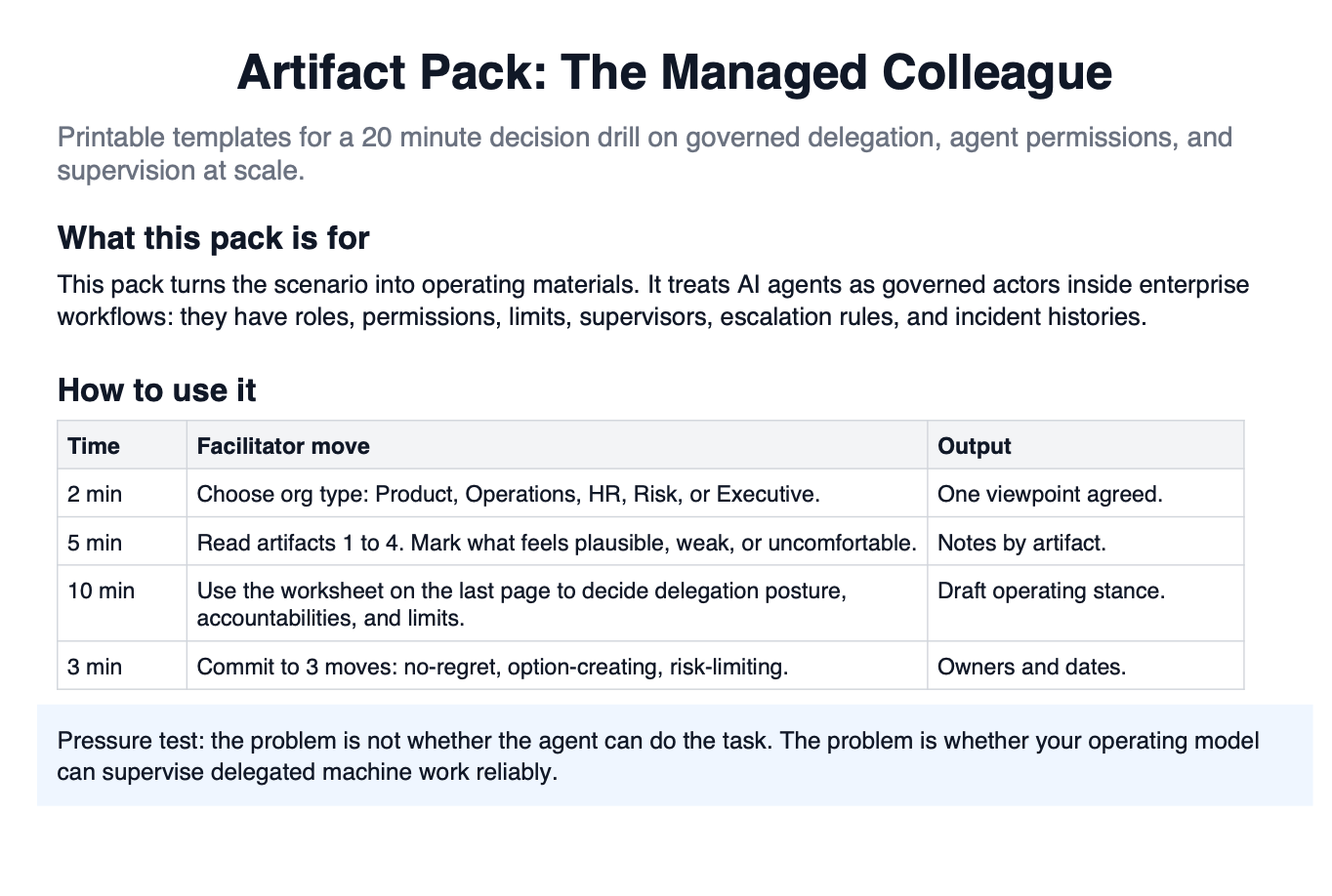
It gives you four ordinary looking internal documents you can use to run a short workshop with a team:
a managed agent profile
a delegation policy memo
an exception review log
a permissions and oversight dashboard
These are the right assets for this case because they cover the real managerial stack:
identity
authority
failure
supervision
Not futuristic visuals. Not vague ethics language. Actual operating materials.
Download: Foresight House - Artifact Pack (The Managed Colleague)
What’s inside:
Artifact 1: Managed Agent Profile
Artifact 2: Delegation Policy for Managed Agents
Artifact 3: Exception Review Log
Artifact 4: Permissions and Oversight Dashboard
Final page: Decision Drill Worksheet
How to use it in 20 minutes
Pick the org type closest to your team: Product, Operations, HR, Risk, or Executive.
Then read the four artifacts and mark three things:
what already feels plausible
what feels weak or performative
what would break first in your current operating model
Then answer four decisions:
What work are we actually willing to delegate?
Where does accountability sit if the agent acts within policy and still causes harm?
What overloads first when agent adoption scales?
What must never be silently delegated?
Then commit to three moves:
one no-regret move
one option-creating move
one risk-limiting move
Why this matters now
A lot of current AI discussion still treats the main risk as bad outputs. That is too narrow.
The next operating problem is unmanaged authority.
Once agents can route approvals, trigger workflows, act on systems, or coordinate across tools, the core failure mode shifts. It becomes less about a single wrong answer and more about bad delegation design:
permissions set too wide
thresholds set too loosely
policy libraries drifting
escalation logic failing quietly
managers inheriting responsibility without real supervisory capacity
That is why this week’s artifact pack is designed to look boring. It should feel like something a real company might already be piloting. The closer it feels to ordinary enterprise material, the more useful the scenario becomes.